


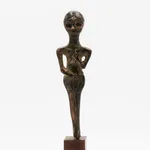
Syrio-Hittite Figure of a Goddess, perhaps Astarte, 3000 BCE - 1800 BCE
Bronze
12.3 x 3.4 x 1.5 cm
4 7/8 x 1 3/8 x 5/8 in
4 7/8 x 1 3/8 x 5/8 in
CC.349
Further images
-
(View a larger image of thumbnail 1
)
-
(View a larger image of thumbnail 2
)

-
(View a larger image of thumbnail 3
)

-
(View a larger image of thumbnail 4
)

-
(View a larger image of thumbnail 5
)

-
(View a larger image of thumbnail 6
)

-
(View a larger image of thumbnail 7
)

-
(View a larger image of thumbnail 8
)

-
(View a larger image of thumbnail 9
)

When we talk about Syro-Hittite sculpture, we are in fact using a modern and slightly misleading label to describe a number of civilised regions in the area of what is...
When we talk about Syro-Hittite sculpture, we are in fact using a modern and slightly misleading label to describe a number of civilised regions in the area of what is now Syria and Turkey. The prefix Syro- refers, naturally, to the Syrian plains which for centuries operated as a kind of regional centre of gravity. In this area, cities such as Nagar – now known as Tell Brak, and famous for its Eye Idols – and Ebla became important trading posts, and significant military-diplomatic powers, which provided a counterbalance to the more densely populated region to the south in Mesopotamia. The ‘Hittite’ part of the name refers to a later civilisation, the Hittites, who inhabited the region of Anatolia from the Seventeenth Century BC, and is used as a kind of shorthand for the bewildering web of independent city-states which characterised Anatolia in the Third and Second Millennia BC. This region was rich, not only as one of the earliest areas to adopt farming, but also as a centre of trade. Artefacts originating in Egypt, the Indus Valley, Sumer, Cyprus and even Afghanistan have been found in its city palaces. The civilisation that grew up in this region was similar in many respects to the Sumerian culture, but there were important differences. Aside from the fact that the region had its own languages – Eblaite being the most well-known, but with Luwian, Hattic and, later, Akkadian and Hittite, as other major language groups – the Syro-Hittite region also employed notably different political structures. In Ebla, for example, women were given a much greater role in the organisation of the state than they were in Sumer, with the Queen of Ebla able to conduct herself independently of the King.
The freedom afforded to women must be connected to the prominence of goddesses in the mysterious religion of the Syro-Hittite region. From even earlier times, the Levant and Anatolia produced thousands of so-called fertility figurines: abstract depictions of wide-hipped, big-breasted women, whose emphasised reproductive regions may imply a kind of fertility or mother goddess. Later, terracotta replaced stone as the main medium for feminine representations. With the change of medium, there also came a change of representation. Whereas the earlier Neolithic figures are round and fairly flat, perhaps reflecting the shapes of the pebbles from which they were carved, the terracotta ‘goddesses’ are taller and narrower, with pinched features formed by the pressing of the potter’s fingers into the wet clay. The figures come in two types, one with the hands brought under the breasts, and the other with small paddle-like arms held out at shoulder-level. While the breasts are generally smaller than in the prehistoric examples, the hips remain wide, and the overall figure has something of an hourglass torso. Small details, such as eyes, nose, mouth, jewellery, hair or headpieces, were easily added with the use of tools, an advantage of this softer material.
This figure is of an elongated form often produced in the Syro-Hittite Region, and which dominates production in bronze. It depicts a female in a form not dissimilar to the fertility figurines produced in the region in Neolithic times: her hips are broad, her pubis incised and exaggerated, her arms brought in to her chest and abdomen. Her breasts, presented as small domes on the otherwise flat surface of the torso, are less exaggerated than her prehistoric forebears, and the face is more clearly defined. Her abstract form is emphasised by a small archaic smile, ad large empty sockets for eyes, with a small punched nose. A hollow at the back of the head, and the fact that this figure could not have been designed to stand on its own – indeed, despite the hollow, it is significantly top-heavy – and so this figure must have been held or laid down for ritual purposes.
The exact meaning of these goddess figures is unknown. Most often, archaeologists associate them with Astarte, one of the three main goddesses of the Canaanite pantheon. She was the northern equivalent to the Mesopotamian goddess Ishtar, and had a broad range of connotations and responsibilities, including war, sexuality, royal power, beauty, healing, and often hunting. She was strongly associated with the lion and the horse, both symbols of masculine authority over which she wielded power. While many earlier scholars tried to associate her directly with the apparent fertility cult which preceded her, it is unclear from the later written sources that she had any such association in ancient times. Instead, she was a feminine guardian of masculine pursuits, and a representation of the power of women in Syrio-Hittite societies. She first appeared in the region in the Third Millennium BC, appearing at Ebla in the form Aštarta or Ištarta, clearly deriving her name from the Sumerian form Ishtar. Her popularity was extraordinary, and terracotta figures which are, like this one, often attributed to Astarte, are one of the most common archaeological remains in the region, appearing in urban, sacral and funerary contexts. But examples of the goddess stood in a temple, hut or shrine are vanishingly rare, setting this remarkable sculpture apart.
The freedom afforded to women must be connected to the prominence of goddesses in the mysterious religion of the Syro-Hittite region. From even earlier times, the Levant and Anatolia produced thousands of so-called fertility figurines: abstract depictions of wide-hipped, big-breasted women, whose emphasised reproductive regions may imply a kind of fertility or mother goddess. Later, terracotta replaced stone as the main medium for feminine representations. With the change of medium, there also came a change of representation. Whereas the earlier Neolithic figures are round and fairly flat, perhaps reflecting the shapes of the pebbles from which they were carved, the terracotta ‘goddesses’ are taller and narrower, with pinched features formed by the pressing of the potter’s fingers into the wet clay. The figures come in two types, one with the hands brought under the breasts, and the other with small paddle-like arms held out at shoulder-level. While the breasts are generally smaller than in the prehistoric examples, the hips remain wide, and the overall figure has something of an hourglass torso. Small details, such as eyes, nose, mouth, jewellery, hair or headpieces, were easily added with the use of tools, an advantage of this softer material.
This figure is of an elongated form often produced in the Syro-Hittite Region, and which dominates production in bronze. It depicts a female in a form not dissimilar to the fertility figurines produced in the region in Neolithic times: her hips are broad, her pubis incised and exaggerated, her arms brought in to her chest and abdomen. Her breasts, presented as small domes on the otherwise flat surface of the torso, are less exaggerated than her prehistoric forebears, and the face is more clearly defined. Her abstract form is emphasised by a small archaic smile, ad large empty sockets for eyes, with a small punched nose. A hollow at the back of the head, and the fact that this figure could not have been designed to stand on its own – indeed, despite the hollow, it is significantly top-heavy – and so this figure must have been held or laid down for ritual purposes.
The exact meaning of these goddess figures is unknown. Most often, archaeologists associate them with Astarte, one of the three main goddesses of the Canaanite pantheon. She was the northern equivalent to the Mesopotamian goddess Ishtar, and had a broad range of connotations and responsibilities, including war, sexuality, royal power, beauty, healing, and often hunting. She was strongly associated with the lion and the horse, both symbols of masculine authority over which she wielded power. While many earlier scholars tried to associate her directly with the apparent fertility cult which preceded her, it is unclear from the later written sources that she had any such association in ancient times. Instead, she was a feminine guardian of masculine pursuits, and a representation of the power of women in Syrio-Hittite societies. She first appeared in the region in the Third Millennium BC, appearing at Ebla in the form Aštarta or Ištarta, clearly deriving her name from the Sumerian form Ishtar. Her popularity was extraordinary, and terracotta figures which are, like this one, often attributed to Astarte, are one of the most common archaeological remains in the region, appearing in urban, sacral and funerary contexts. But examples of the goddess stood in a temple, hut or shrine are vanishingly rare, setting this remarkable sculpture apart.